By: Shiyang (Ann) Lu (DPhil in Chemistry, 2024)
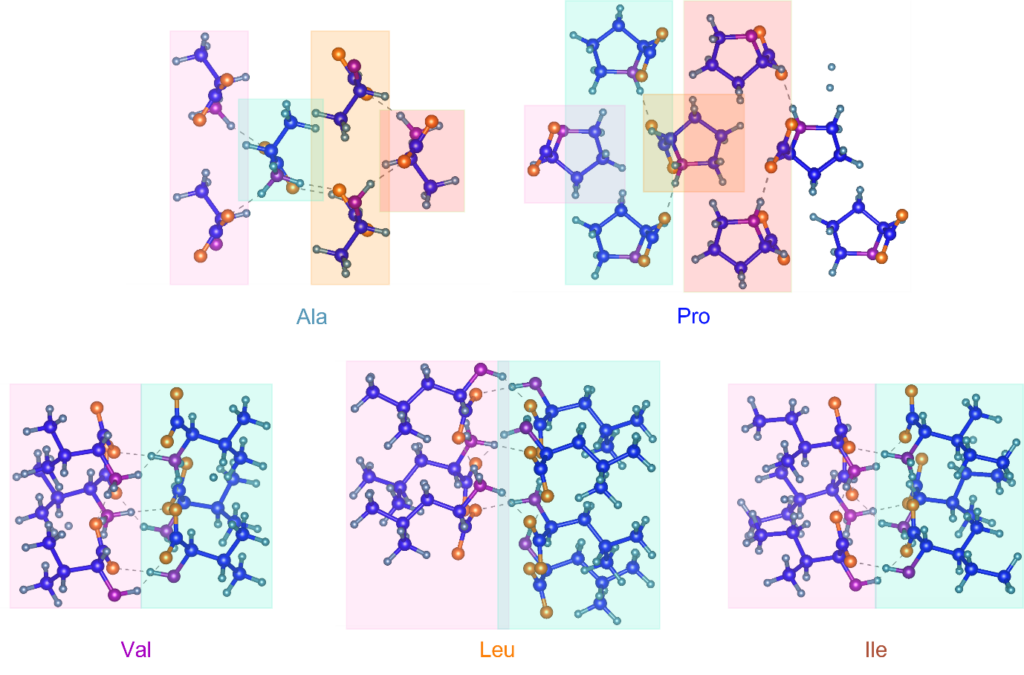
This image shows the crystal structures of several proteinogenic amino acids – alanine (Ala), proline (Pro), valine (Val), leucine (Leu), and isoleucine (Ile). Although best known as the building blocks of proteins, in the solid state these molecules form highly ordered crystalline materials with distinct packing motifs and intermolecular interactions. The coloured sections highlight structural sub-motifs within each crystal. These differences arise from variations in molecular structure and hydrogen bonding networks. Together, local chemical environments and long-range interactions influence how electrons are distributed throughout the material.
My DPhil research uses photoelectron spectroscopy (PES) to probe this electronic structure. In PES, X-ray ionise atoms within the crystal, causing electron emission. The energy of these photoelectrons can then be measured, providing direct information about chemical bonding and the local atomic environment. However, interpreting the resulting spectra for molecular crystals is far from straightforward: signals from different atoms and bonding environments overlap, and amino acids are particularly sensitive to radiation-induced damage during measurement.
To overcome these challenges, I combine experimental observations with density functional theory calculations. Starting from the crystal structures shown here, I simulate photoelectron spectra and compare them directly with experiment. This approach allows us to explore core state electrons which are indicative of the local chemical environment of individual elements within the amino acids. The excellent agreement between calculated and measured core-level energies we achieve has allowed us to confidently assign spectral features and disentangle local chemical effects from broader crystal packing influences. Extending the analysis to valence electrons, responsible for chemical bonding, reveals how local coordination and crystal packing shape the overall electronic behaviour.
By developing a reliable, theory-assisted framework for analysing photoelectron spectra, this work establishes amino acid crystals as benchmark systems and opens the door to studying more complex organic and bio-inspired materials.
Shiyang (Ann) graduated with an MSci in Chemistry from University College London in 2024. In the same year, she started her DPhil at Oxford, where her research focuses on exploring the structure – electronic structure relationship of prototypical material families using a combination of X-ray diffraction, X-ray photoelectron spectroscopy (XPS) and density functional theory (DFT), under the supervision of Prof. Anna Regoutz and with the collaboration of Dr. Laura Ratcliff at the University of Bristol. Her interest in studies that combine theoretical and experimental aspects developed during her fourth-year research project at UCL, where she investigated the electronic structure of organic light emitting diode materials using DFT and XPS. Apart from chemistry, she loves dancing and playing table tennis. Connect with Shiyang via LinkedIn.