By: Isabel Black (DPhil DTP in Environmental Research, 2023)
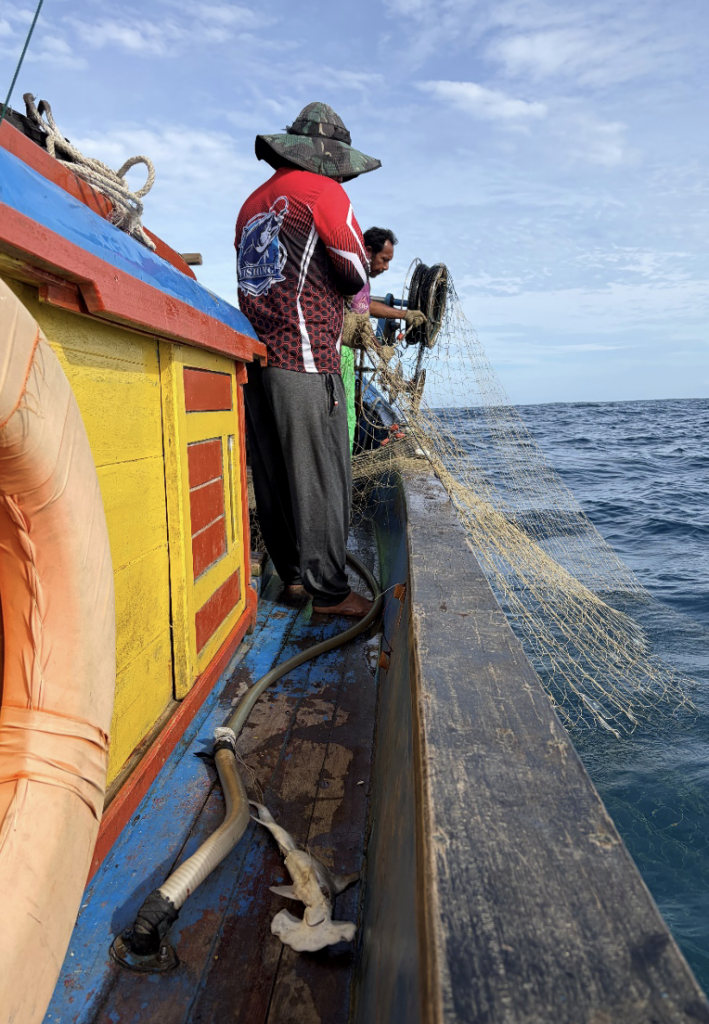
In May each year, fishers in Aceh Jaya, Indonesia, report a remarkable pattern: for just a few weeks, pregnant Critically Endangered scalloped hammerhead sharks appear in shallow coastal waters and are caught in fishing nets before disappearing again. No one knows where these females come from, or where they go next. All we do know is their babies are caught in their hundreds in the following months.
For a Critically Endangered species, this is not simply an interesting mystery. It could be the key to protecting an entire population of sharks.
My DPhil research focuses on shark and ray conservation in remote and data-poor regions. These are places where conservation is urgent, but the evidence needed to make good decisions is incomplete. Sharks and rays are the most threatened groups of marine vertebrates. They grow slowly, mature late, and have relatively few offspring. This means that populations can decline quickly when fishing pressure is high, but recover very slowly even when protections are introduced.
This creates a serious problem. To protect a species effectively, we need to know where it is, when it is most vulnerable, and how it interacts with humans. Yet, in many coastal regions, especially those dominated by small-scale fisheries, those basic data points do not exist. Landings records may be incomplete, species may be recorded inaccurately, and fishing locations can be difficult to map. At the same time, sharks and rays are often deeply connected to people’s livelihoods, contributing to food and income in communities where conservation decisions have very real human consequences.
This is the question at the core of my work: how do we protect threatened sharks and rays in a way that is scientifically robust, but also fair and realistic for the people who share the coast with them?
For me, collaborating with fishers is not optional. Conservation is far more likely to succeed when those whose behaviour you’re asking to change are involved in shaping the solution. When fishers feel ownership, agency, and stewardship over their own marine territory, they are more likely to support conservation measures and less likely to participate in illegal behaviours. You cannot simply ban shark fishing, therefor removing someone’s income, and expect the rules to be respected.
In Aceh Jaya, I work closely with the local NGO Kebersamaan Untuk Lautan, who are working with communities to reach conservation solutions. The Aceh Jaya coastline is used by small-scale fishers but is also an important nursery area for Critically Endangered scalloped hammerhead (Sphyrna lewini) and bottlenose wedgefish (Rhynchobatus australiae). Rather than resorting to large permanent closures or fishing bans, my research asks whether we can be more precise. If we can use ecological monitoring to identify exactly when and where the most vulnerable life stages overlap with fishing activity, then we may be able to design targeted interventions that reduce shark mortality while minimising disruption to fishers.
To do this, I combine ecological monitoring, fisheries data, and local knowledge. One of my main methods is Baited Remote Underwater Video, or BRUVS. These underwater camera rigs placed on the seabed allow us to observe sharks and rays without catching them. They are particularly useful in data limited fisheries, because they provide an independent way to measure which species are present, where they occur, and how their habitat use changes across different areas.
Alongside these camera surveys, I use both landings data and local ecological knowledge from fishers. Landings data show what is being caught and where. We use this to look at how catches change over time, and which gear type (e.g. bottom nets or drifting nets) or season is associated with the highest risk for sharks. Local ecological knowledge adds context behind those patterns, drawing on fishers’ long-term experience of their local environment. In this case, fishers’ observations of pregnant hammerheads, combined with peaks in juvenile catches in the following months, may point towards a predictable yearly pupping season. This creates a clear target for management, such as a short closure during the period when the most vulnerable sharks are present. This could provide the largest reduction in shark mortality with minimal disruption to fishers’ livelihoods.
The aim is not conservation for conservation’s sake, detached from the human realities of ecosystem use. The aim is to generate empirical evidence that can support practical decisions. An intervention that is carefully designed is far more likely to be accepted, socially enforced, and effective than one that ignores local realities.
What excites me most about this work is the way it brings different kinds of knowledge together. Every data source reveals a different piece of the same puzzle. Alone, each is incomplete. Together, they can show us how sharks use the seascape, where they are most at risk, and how conservation can be designed to protect both biodiversity and livelihoods.