By: Leah Tavasi (DPhil in Environmental Research (NERC DTP), 2023)
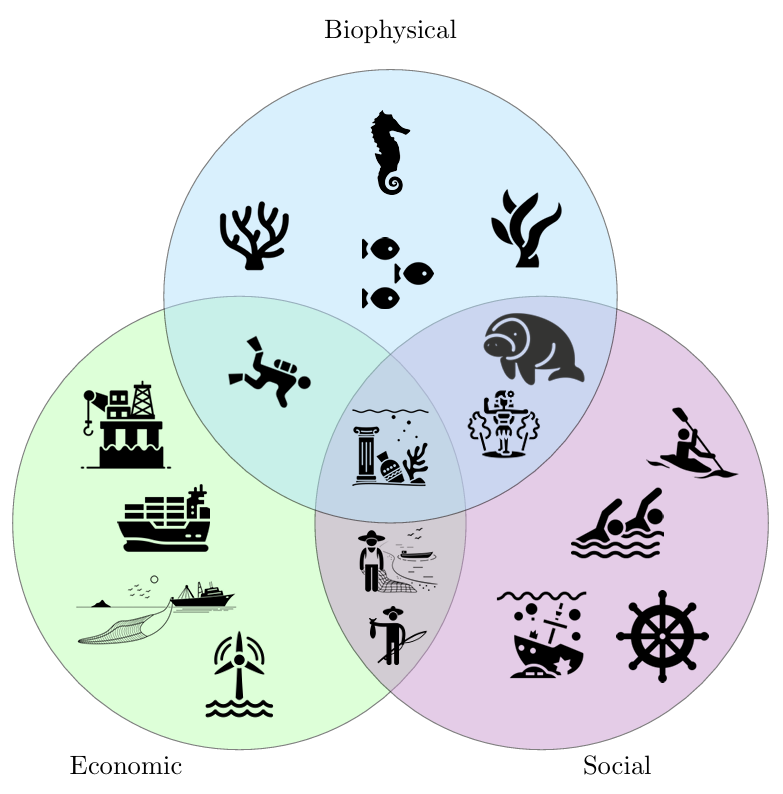
In marine management frameworks, the ocean is commonly divided into three theoretical dimensions: economic, biophysical, and social. Extensive focus has been placed on the economic and biophysical dimensions, which encompass ecological processes as well as industries such as world trade and green energy. By contrast, the social dimension remains the least defined, enabling its marginalisation in both research and practice. It is frequently treated as a residual category for anything not easily classified as biophysical or economic, and practitioners often assume that the social cannot be spatialised or quantified. Although social measurement tools exist in other disciplines, many remain convinced that the complexity of social phenomena prevents their integration alongside the more quantitative economic and biophysical dimensions. As a result, despite being presented as an equal pillar, the social dimension has remained conceptually opaque, perpetuating the fiction of an ‘unpeopled’ ocean and obscuring the depth of human-ocean relationships that shape marine space. It therefore emerges as the missing architecture of ocean governance: widely invoked but rarely defined.
To provide structure to the social dimension, a framework is developed that identifies three interlocking appeals that together capture the full range of human-ocean relationships: equity, culture, and livelihood. By reconstructing the social dimension into descending appeals, aspects, attributes, and variables, and by tracing how people inhabit, use, and value the ocean, the framework gives form to a core component of how societies understand and occupy marine space. Rather than being treated as an optional supplement, culture becomes evidence of deep temporal relationships with the sea and a foundation for contemporary governance. Together, the three appeals demonstrate that management, and therefore resilience, is not only economic and ecological but also social; in other words, communities can adapt more effectively when the management frameworks that sustain them are stable and accessible.
Equity encompasses rights, justice, wellbeing, and the uneven distribution of benefits and burdens. It asks who is affected, who is included, and who is excluded: questions that are particularly salient in coastal and island contexts where climate impacts disproportionately affect communities with limited political influence.
Culture forms the second appeal and is the most expansive. It includes tangible and intangible heritage, identity, ritual, language, food, and the deep temporal relationships that people maintain with the sea. By placing the maritime cultural landscape within this pillar, the framework reframes archaeology as evidence of enduring human-ocean entanglements. Culture is understood not as a static inheritance but as a living practice that shapes how communities perceive risk, value ecosystems, and imagine their futures.
Livelihood grounds the social dimension in material conditions such as food systems, settlement patterns, mobility, governance structures, and access to marine resources. It captures the everyday realities that determine whether communities can adapt to environmental and social change. Whereas equity focuses on rights and recognition, livelihood focuses on needs and infrastructures.
For the social dimension to be integrated meaningfully into marine management, it must be measurable. Indicators such as life expectancy, education, and employment for equity; fishing location density, food access, and settlement stability for livelihood; and heritage site density, cultural ecosystem services, and identity strength for culture demonstrate that social data can be spatial, quantitative, and operationally useful. Without such metrics, the social dimension will continue to be overshadowed by biophysical and economic data, which are more readily quantified and therefore more easily incorporated into planning frameworks. By offering quantifiable and spatially meaningful metrics across all three appeals, the framework provides a pathway for integrating the social dimension into marine management on equal footing with biophysical and economic considerations. This shift is essential for transforming marine governance from a technocratic exercise into a genuinely holistic approach.
The broader societal relevance of this conceptualisation lies in its capacity to reorient marine governance toward the lived realities of coastal and maritime communities. By demonstrating that the social dimension is not an amorphous category but a structured set of relationships, histories, and material conditions, the framework challenges the persistent marginalisation of human concerns in ocean policy. It shows that cultural heritage, identity, and livelihood are not peripheral to sustainability but foundational to it. This has significant implications for climate adaptation, conservation planning, and heritage protection, and it positions maritime archaeology as a discipline capable of contributing substantively to contemporary environmental governance. The resulting framework offers a means of integrating social considerations into marine planning on equal footing with ecological and economic concerns, restoring people to the centre of ocean governance and recognising cultural heritage as a vital component of how societies understand, inhabit, and respond to environmental change.
Leah is a PhD student in the NERC DTP environmental research, looking at how maritime heritage can contribute to environmental resilience. She holds a master’s degree in maritime archaeology from Oxford and a bachelor’s degree from McGill University. She has worked as a Maritime Archaeologist at the St. Augustine Lighthouse and Maritime Museum and is also a PADI Specialty Instructor, DAN Instructor, and research diver at the Coral Restoration Foundation. Learn more about Leah here.